 YouTip
Naive Bayes
\n\nImagine you're browsing an online bookstore. Based on your previous purchases of The Three-Body Problem and The Wandering Earth, the system recommends Ball Lightning to you. Behind this "Guess You Like" feature, the algorithm we're going to discuss today—Naive Bayes—is very likely being used.
\n\nNaive Bayes is a simple yet efficient probabilistic classification algorithm based on Bayes' theorem.
\n\nThe core idea of Naive Bayes is: by using known features (such as books you've purchased), calculate the probability of a certain event (such as whether you'll like another book), and select the category with the highest probability as the prediction result.
\n\nIts "naive" aspect lies in a key assumption: all features are mutually independent. That is, when determining whether you like Ball Lightning, the algorithm assumes that purchasing The Three-Body Problem and purchasing The Wandering Earth are unrelated factors in your decision. Although in reality features are often correlated, this simplified assumption makes computation extremely efficient, and surprisingly effective in many practical scenarios (especially text classification).
\n\n\n\n
Core Principle: Bayes' Theorem
\n\nTo understand Naive Bayes, you must first understand its foundation—Bayes' theorem. It describes how to update the probability of an event occurring given certain conditions.
\n\n1. Bayes' Formula
\n\nThe formula may look abstract, but let's understand it through an example:
\n\n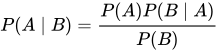
P(A|B) = [P(B|A) * P(A)] / P(B)
\n\nScenario: Determining whether an email is spam.
\n\n- \n
- A: The event that the email is "spam". \n
- B: The feature that the email contains the word "free". \n
- P(A): The prior probability that any email is spam (e.g., based on historical data, 20 out of 100 emails are spam, so P(spam) = 0.2). \n
- P(B|A): The conditional probability that the word "free" appears given that the email is spam (e.g., 80% of spam emails contain "free", so P(free|spam) = 0.8). \n
- P(B): The total probability that the word "free" appears in any email. \n
- P(A|B): What we ultimately want to find—the posterior probability that the email is spam given that it contains the word "free". \n
The essence of Bayes' theorem: It uses information we already know (the general pattern of spam emails P(A) and spam email vocabulary habits P(B|A)), combined with newly observed evidence (this email contains "free"), to revise our judgment of this specific event (the likelihood that this email is spam P(A|B)).
2. Where is the "Naive"?
\n\nA true Bayes classifier needs to consider the joint probability P(B1, B2, B3... | A) of all features (B1, B2, B3...) when calculating P(B|A), which is very complex.
Naive Bayes makes a powerful simplifying assumption: all features are conditionally independent. This means:
\n\nP(B1, B2, B3... | A) ≈ P(B1|A) * P(B2|A) * P(B3|A) * ...
\n\nThis assumption transforms complex joint probability calculations into multiplications of multiple simple probabilities, greatly reducing computational cost.
\n\n\n\n
III. Workflow and Classifier Types
\n\nThe workflow of Naive Bayes classifier can be summarized in the following steps:
\n\nDepending on the type of feature data, Naive Bayes has several variants:
\n\n| Classifier Type | \nApplicable Feature Data Type | \nCore Assumptions and Description | \nTypical Application Scenarios | \n
|---|---|---|---|
| Gaussian Naive Bayes | \nContinuous data | \nAssumes that each feature follows a Gaussian distribution (normal distribution) under each class. | \nClassifying gender based on height and weight; classifying iris species based on petal dimensions. | \n
| Multinomial Naive Bayes | \nDiscrete count data | \nAssumes that features are generated by a multinomial distribution. Particularly suitable for text classification, where features are typically word occurrence counts or TF-IDF values. | \nSpam filtering, news topic classification, sentiment analysis (positive/negative reviews). | \n
| Bernoulli Naive Bayes | \nBinary data (0/1) | \nAssumes that features are binary (present or not), following a Bernoulli distribution. It focuses on "whether it appears" rather than "how many times it appears". | \nText classification (using word set model), user behavior analysis (whether clicked, whether purchased). | \n
\n\n
IV. Hands-on Practice: Implementing Spam Classification with Python
\n\nLet's use a simplified example to implement a spam classifier based on Multinomial Naive Bayes.
\n\n1. Scenario and Data Preparation
\n\nWe have some labeled email texts (spam or ham for normal emails).
Example
\n\n# Example training data: each line is an email content, followed by label ('spam' or 'ham')\n\ntrain_data = [\n (""Win a free iPhone grand prize! Click the link", "spam"),\n (""Boss, meeting at 3 PM, please attend on time", "ham"),\n ("Congratulations, you've won! Claim your prize now", "spam"),\n ("The project report has been sent to your email, please check it", "ham"),\n (""Limited-time offer, 50% off everything, today only", "spam"),\n (""Weekend dinner is set for 7 PM at the usual place", "ham")\n]\n2. Code Implementation Steps
\n\nExample
\n\n# Import necessary libraries\nfrom sklearn.feature_extraction.text import CountVectorizer\nfrom sklearn.naive_bayes import MultinomialNB\nfrom sklearn.pipeline import make_pipeline\nimport numpy as np\n\n# Example training data: each line is an email content, followed by label ('spam' or 'ham')\ntrain_data = [\n (""Win a free iPhone grand prize! Click the link", "spam"),\n (""Boss, meeting at 3 PM, please attend on time", "ham"),\n ("Congratulations, you've won! Claim your prize now", "spam"),\n ("The project report has been sent to your email, please check it", "ham"),\n (""Limited-time offer, 50% off everything, today only", "spam"),\n (""Weekend dinner is set for 7 PM at the usual place", "ham")\n]\n\n# 1. Prepare data: separate text and labels\ntexts = [data for data in train_data] # Email text list\nlabels = [data for data in train_data] # Corresponding label list\n\n# 2. Create and train model pipeline\nmodel = make_pipeline(CountVectorizer(), MultinomialNB())\nmodel.fit(texts, labels)\n\n# 3. Prepare new emails for prediction\nnew_emails = [\n "Get a free coupon, a rare opportunity!", # Expected spam\n ""Tomorrow at 10 AM, phone conference to discuss the budget" # Expected ham\n]\n\n# 4. Make predictions\npredictions = model.predict(new_emails)\nprediction_proba = model.predict_proba(new_emails) # Get prediction probabilities\n\n# 5. Output results (fix quote issues + dynamically match probability labels)\n# Get model's class order (avoid hard-coded indices)\nclass_names = model.classes_\n\nfor email, pred, proba in zip(new_emails, predictions, prediction_proba):\n # Fix nested quote issues: use single quotes for inner layer, or single quotes for outer layer\n print(f'Email content: "{email}"')\n print(f" Predict category: {pred}")\n # Dynamically output probability for each class (more robust)\n for cls, prob in zip(class_names, proba):\n print(f" Belongs to'{cls}'probability of: {prob:.4f}")\n print("-" * 40)\n3. Code Analysis
\n\nData separation: Store texts and labels from the training data into two separate lists, which is the format required by the sklearn library.
Building the model pipeline:
\n\n- \n
CountVectorizer(): This is a text feature extractor. It converts each email (a piece of text) into a numerical vector. Each position in the vector represents a word (such as "free", "meeting"), and the value represents how many times that word appears in the email. \nMultinomialNB(): This is our Multinomial Naive Bayes classifier. It receives the numerical vectors generated in the previous step and learns the probabilistic relationship between these vectors and the labels (spam/ham). \nmake_pipeline()automatically chains these two steps together—transforming first then classifying during training, and likewise during prediction. \n
Model training: model.fit(texts, labels) is the core training process. The algorithm calculates here:
- \n
- Prior probabilities
P(ham)andP(spam). \n - Conditional probabilities
P(word | ham)andP(word | spam)for each word under thehamandspamcategories. \n
Prediction and output: For new emails, the model first converts them into feature vectors, then calculates the probability of belonging to each category according to Bayes' formula, and finally outputs the category with higher probability.
\n\nOutput:
\n\nBelongs to'ham'probability of: 0.5000 Belongs to'spam'probability of: 0.5000----------------------------------------Email content: ""Tomorrow at 10 AM, phone conference to discuss the budget" Predict category: ham Belongs to'ham'probability of: 0.5000 Belongs to'spam'probability of: 0.5000\n\n
V. Advantages, Disadvantages and Considerations
\n\nAdvantages
\n\n- \n
- Simple and efficient: Simple principle, very fast training and prediction speed, suitable for large-scale datasets. \n
- Performs well with small-scale data: Even with limited training data, it can achieve good results. \n
- Suitable for high-dimensional data: Particularly good at handling data with very high feature dimensions (such as text with many words). \n
- Relatively robust to irrelevant features: Due to the "naive" independence assumption, individual irrelevant features have less impact on the overall result. \n
Disadvantages and Considerations
\n\n- \n
- Limitations of the "naive" assumption: In reality, features are often correlated, and this strong assumption may affect accuracy. For example, in text, "New York" and "Times" often appear together and are not independent. \n
- Accuracy of probability estimation: The calculated "probability" values are more for classification ranking, and their absolute values may not be completely accurate. \n
- Zero probability problem: If a feature never appears in a certain class in the training set, its conditional probability is 0, which will cause the entire posterior probability to be 0. Laplace smoothing (set via the
alphaparameter insklearn) is commonly used to solve this—adding a small constant to the count of all features to avoid zero values. \n
\n\n
VI. Exercises and Challenges
\n\nTo consolidate your understanding of Naive Bayes, try the following exercises:
\n\n- \n
- Modification exercise: In the code above, try adding more training data, especially emails containing words like "link", "meeting", "report", and observe changes in prediction results and probabilities. \n
- Parameter tuning: Consult the
sklearndocumentation to learn about thealphaparameter (smoothing parameter) inMultinomialNB. Try setting it to 0.1, 0.5, 1.0, and see what effect it has on prediction probabilities. \n - Change classifier: Replace
MultinomialNB()in the code withBernoulliNB()(Bernoulli Naive Bayes). Note thatCountVectorizermay need to setbinary=Trueto generate binary features. Compare the performance of both on simple examples. \n - Practical challenge: Use the
fetch_20newsgroupsdataset built intosklearn(a classic news text classification dataset), and try using Naive Bayes to classify news of different topics. \n
Naive Bayes is an excellent starting point for entering machine learning. It demonstrates the charm of probability theory with concise mathematical formulas, and with its practicality firmly occupies a place in text classification, recommendation systems, sentiment analysis, and other fields. Understanding it, you have mastered the first key to unlocking the black boxes of many intelligent applications.